miércoles, 25 de mayo de 2011

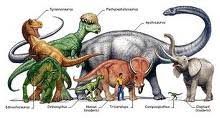
Birds are dinosaurs!!!


The Strongest Evidence of Dinosaur Heritage:

Many anatomical reasons (some in dispute) have been offered for linking birds to dinosaurs; but the strongest evidence is circumstantial:

birds fly north to nest!

Birds fly north because of dinosaur heritage. North flight is the remnant of an ancient scheme. Birds evolved from predatory theropod dinosaurs that swam in attendance with the herds of herbivores on their periodic treks and that reared their own young at the herd periphery. The dinosaur had begun 230 million years ago to be genetically wired for a seasonal trip to the north – about 90 million years before a theropod line evolved into the first bird. Marine migrations of ancient dinosaurs are no more; but the genetodynamic compulsion to fly north to nest in season lingers in numerous bird genera. The herd was father to the flock.

Today, birds fly north to lay their eggs and to fledge their young in relative safety. Flocks (in analogy to herds) fly back and forth in season over the Mediterranean, the remnant of the western Tethys.


Taken from: http://www.flwildflowers.com/birdsdinosaurs/

Learn more at: http://teacher.scholastic.com/activities/dinosaurs/

http://www.kidsdinos.com/

miércoles, 18 de mayo de 2011

Amazing Australia...

Emus have been walking the plains of Australia for about 80 million years. The Emu was around when the dinosaurs still walked the plains. They knew Australia when it was covered in rainforest.

The Emu's ability to survive such changes says much about its adaptability. According to folklore, Emus have a mysterious mechanism that tells them where the rain is, and will travel for hundreds of kilometers to find it.

They are nomadic and feed on grains, flowers, fruit, soft shoots, insects, mice, grubs, and even other animal dung. They are powerful swimmers and and capable of crossing any river. Although they must drink every day, they are very good conservers of water. Their feathers deflect most of the sun's heat which allows them to forage right through the day when nearly all other animals must take shelter.

They also have a great sense of curiosity and will investigate anything unusual. When hunting, some Aborigines used to exploit this curiosity.

Learn more about emus at:
http://www.convictcreations.com/animals/emu.htm

Learn about other Australian animals at:
http://www.convictcreations.com/animals/index.htm

Learn more about Australia at:
http://www.australia.com/


Share your findings!!!!

miércoles, 6 de abril de 2011

Water for life!!!


No living being on planet Earth can survive without it.


It is needed for human health and well-being as well as for the preservation of the environment.However, four of every ten people in the world do not have access to a toilet; and nearly two in ten have no source of safe drinking water.


Every year millions of people, most of them children, die from diseases associated with inadequate water supply, sanitation, and hygiene.

According to the World Health Organization, each and every day some 3,900 children die because of dirty water or poor hygiene; diseases transmitted through water or human excrement are the second-leading cause of death among children worldwide, after respiratory diseases.


Water scarcity, poor water quality, and inadequate sanitation negatively impact food security, livelihood choices, and educational opportunities for poor families across the world. Water-related natural disasters such as floods, tropical storms and tsunamis exact a heavy toll in human life and suffering. And all too regularly, drought afflicts some of the world’s poorest countries, exacerbating hunger and malnutrition.


Beyond meeting basic human needs, water supply and sanitation services, as well as water as a resource, are critical to sustainable development. It is a major source of energy in some parts of the world, while in others its potential as an energy source remains largely untapped.Water is also necessary for agriculture and for many industrial processes. And in more than a few countries, it makes up an integral part of transport systems.


With improved scientific understanding, the international community has also come to appreciate more fully the valuable services provided by water-related ecosystems, from flood control to storm protection and water purification.


Water challenges will increase significantly in the coming years. Continuing population growth and rising incomes will lead to greater water consumption, as well as more waste. The urban population in developing countries will grow dramatically, generating demand well beyond the capacity of already inadequate water supply and sanitation infrastructure and services. According to the UN World Water Development Report, by 2050, at least one in four people is likely to live in a country affected by chronic or recurring shortages of freshwater.


It seems there are more than few reasons to put water and sanitation at the top of the world’s agenda...


What do you think???

miércoles, 9 de marzo de 2011

Did you know?


Why is blue for boys and pink for girls?


In ancient times, it was believed that certain colors could fight evil spirits that were related to nurseries. Which ones? _____________________________________________________
_____________________________________________________

Blue was associated with the heavenly spirits and so boys wore that colour as then boys were considered the most valuable resource to parents. Why?
_____________________________________________________
_____________________________________________________.

Although baby girls did not have a color associated with them, they were mostly clothed in black. It was only in the Middle Ages when pink became associated with baby girls.Why? ____________________________________________________
____________________________________________________

Go to the webpage: http://www.didyouknow.org/

Which is your favourite article? __________________________________________________

Watch the video: Did you know?

Which figure shocked you most? __________________________________________________


Make your comments!

martes, 22 de febrero de 2011

Pele: The Tale Of The Volcano Goddess

Native Hawaiians thought that volcanic eruptions were caused by Pele, the beautiful Goddess of Volcanoes. Pele had frequent moments of anger, which brought her eruptions. She was honored but also feared (she could cause earthquakes by stamping her feet or volcanic eruptions by digging with her Pa'oa, her magic stick).


Pele had an argument with her older sister, Namakaokahai. The fight ended up forming the Hawaiian Islands.

Pele used her magic stick on Kauai, but she was attacked by her older sister. Pele recovered and fled to Oahu, where she dug several "fire pits," including the crater we now called Diamond Head, in Honolulu.


After that, Pele left her mark on the island of Molokai before travelling to Maui and creating the Haleakala Volcano. Namakaokahai, Pele's older sister, realized she was still alive and she went to Maui to find her. After a terrific fight, Namakaokahai believed that she had killed her younger sister. But Pele was still alive and she was busy working at the Mauna Loa Volcano, on the big island of Hawaii.

Finally, Namakaokahai gave up the struggle. Pele dug her final eternal fire pit, Halemaumau Crater, at the summit of Kilauea Volcano.

She is said to live there to this day...


Get to know more about volcanoes and how to prevent disasters at: http://www.fema.gov/kids/


Extra activities on volcanoes: worksheets


Answer these questions:

1. What was the most destructive volcanic eruption we know? _____________________________________________


How many lives did it take?__________________________


2. Approximate how many volcanoes are active in the world at this time? ____________________________

Name five of those you remember (or look for them)
______________________________________
______________________________________
______________________________________
______________________________________
______________________________________


3. What are some positive things we may get from volcanoes?
______________________________________
______________________________________
______________________________________
______________________________________


Still want more?: Click this Reading / Comprehension

domingo, 13 de febrero de 2011

Gorillas


Gorillas communicate in several ways. They often mix sounds with actions.
When gorillas beat their chest with their hands, it is a warning signal to others to show they are "in charge".


Researchers have identified 25 different sounds made by gorillas and their meaning but there are many more that we don’t understand yet. They make chirps, grunts, roars, growls, and even hooting like an owl. They can be funny too, laughing and sticking their tongue out.


Gorillas use their communication to find food, to offer help, to express distress, for developing social relationships...


Certain members can develop forms of slang as we do in our social groups. This means that their communications are often learned and not just product of the use of the instinct.

Gorillas can also been taught how to communicate by humans. One successful story is that of KoKo: She was taught how to use sign language.


They hear and use noises that humans can’t even hear and that is how they are usually alerted to dangers. They also rely on their sense of smell.


Young gorillas have communications which are similar to those of human babies including whining and crying. Their mothers can find out what they need easily.


There are 9 steps to the gorilla communication ritual: First they will offer hooting sounds that get faster, feed in a methodical way, jump up and down, throw food, beat their chest with both hands, kick with their legs, run sideways, tear at vegetation out there, and end with their palms hitting the ground and more hooting sounds.

Researchers continue decoding their language, it isn’t an easy task. It is like trying to take a completely foreign language and learning it on your own. As many of the different sounds seem to have several meanings, the task is even more difficult...


martes, 8 de febrero de 2011

Dolphins and communication

Dolphins are considered to be the most intelligent mammals and researchers believe much of the dolphin's brain is used for communication or "echolocation".

While we still don't know if dolphins have a formal language, they do communicate with a "personal" whistle to identify themselves.

Unlike humans, dolphins do not have vocal cords, but they do use a complicated system of whistles, squeaks, moans, trills and clicks produced by their blow hole muscle.


Using echolocation, or sonar, dolphins send out frequencies by clicking. The returning sound waves are picked up by the dolphin's forehead and lower jaw and interpreted as to distance, size and shape of object.

This sound system is particularly useful at night as it allows the dolphin to navigate even if visibility is poor.

Dolphins have produced sound frequencies from 0.25 to 200 kHz, using the higher frequencies for echolocation and the lower frequencies for communication and orientation.


Do you want to learn more? Click on one of these:


The Dolphin Communication Project

What are dolphins?

Dolphin facts

Dolphin World!